
0.01 BTC as a Milestone: Reading Pool State Before You Set a Target
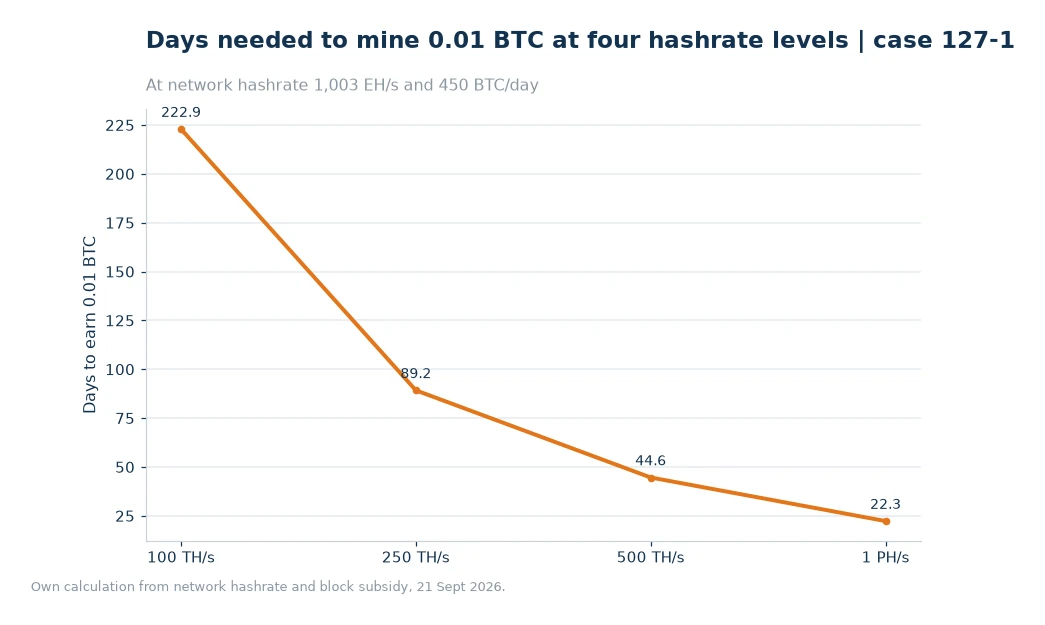
One hundredth of a bitcoin is the kind of round number people adopt without checking what it demands. At 100 TH/s it takes 222.9 days of continuous mining at today's network figures; at 1 PH/s the same target arrives in 22.3 days. The gap between those two calendars is not a matter of effort or luck. It is arithmetic on hashrate, and the pool state page is where the inputs live.

Key takeaways
- At 100 TH/s, 0.01 BTC needs 222.9 days; at 500 TH/s the same goal needs 44.6 days.
- Pool Hashrate tells you what share of the network the pool controls, which is a different number from your own share.
- Pool Luck explains why block discovery is uneven, and why PPS+ insulates hourly credits from that unevenness.
- Doubling hashrate halves the calendar but not the cost of the hardware, so the target should be priced in both days and dollars.
Why one hundredth of a bitcoin is a useful unit
A target is only useful if it is small enough to reach and large enough to matter. 0.01 BTC sits in that band for a single-machine miner: it is a visible milestone, it is easy to compare against a hardware invoice, and it does not require pretending that a home setup is an industrial operation. It also converts cleanly into a date, which is the real reason to pick it.
The conversion depends on one assumption that has to be stated openly: difficulty stays where it is. It will not. Every adjustment changes the denominator, and a target measured in months will drift as those adjustments land. Treat any date you calculate as a snapshot rather than a schedule, and re-run the sums when the network moves enough to matter.
Pool Hashrate is the denominator's first cousin
Your share of the reward is your hashrate divided by the network total, not by the pool total. The network figure on 21 Sept 2026 was about 1,003 EH/s, and 450 BTC a day was being issued across it. Pool Hashrate is a separate and equally useful number: it describes how much of that network the pool itself represents, which shapes how often the pool finds blocks and therefore how visible Pool Luck becomes.
The state view behind the ViaBTC BTC Mining Pool shows the network total and the pool's own contribution next to each other, refreshed as conditions change. Read them in that order. The network figure sets your output, and the pool figure sets the cadence of block finds; neither is a forecast. A number copied on a quiet Sunday will differ from the same number during an adjustment window, so write the read date beside any target you calculate. A goal without a date on its inputs is a wish, and a goal with a stale date is worse, because it looks like a plan.
Miners mix these up constantly. A pool with a large share finds blocks frequently, so its luck series looks calm and its payout cadence feels steady. A smaller pool finds fewer blocks, so the same luck in percentage terms produces longer gaps. Under PPS+, neither pattern changes your hourly credit, because the block-reward component is settled against difficulty rather than against the pool's recent finds. Under PPLNS it does change the rhythm, and the last five difficulty rounds become the window that matters.
Pool Luck, and who carries it
Blocks arrive on a random schedule even when hashrate is constant. Pool Luck measures how actual finds compare with the statistical expectation for the pool's share. A lucky stretch finds more blocks than expected; an unlucky one finds fewer. Neither is a malfunction, and neither is predictable from the previous stretch.
This is the single clearest difference between the two settlement schemes. PPS+ hands the block-reward portion to the miner at a fixed rate per share and keeps the luck on the pool's side of the ledger. PPLNS shares whatever the pool actually finds across the last five difficulty rounds, so the miner carries a slice of the variance in exchange for a lower listed rate on the combined components. A miner saving toward a fixed date should know which of those two they are running, because one produces a smooth line and the other produces a lumpy one.
Four hashrates, four calendars
The table holds the target at 0.01 BTC and moves only the machine size. The ninety-day column is there to make the practical question visible: how much of the target exists after a quarter of ordinary running.
The milestone after this one
Finishing 0.01 BTC invites a larger target, and the arithmetic scales without surprises. Doubling the goal doubles the days at the same hashrate: 200 TH/s needs 445.8 days for 0.02 BTC. That is worth knowing before the celebration, because the second milestone usually takes longer than the first felt like it did.
The reason is not mathematical but psychological. The first target is met while enthusiasm is high and the machine is new; the second is met after a difficulty adjustment or two, with the hardware no longer novel. Planning the next date from the current network figure, rather than from the pace of the first run, keeps the expectation honest.
| Rig | Daily coins | Days to the milestone | Coins by day 90 |
|---|---|---|---|
| 100 TH/s | 0.00004486 | 222.9 | 0.004037 |
| 250 TH/s | 0.00011215 | 89.2 | 0.010094 |
| 500 TH/s | 0.00022430 | 44.6 | 0.020187 |
| 1 PH/s | 0.00044861 | 22.3 | 0.040374 |
Worked example
Take the smallest machine in the table and follow the whole chain, including the step where the target becomes a date.
- Per-terahash rate: 450 ÷ 1,003,000,000 = 4.4865e-7 BTC per day, rounded to 4.5e-07.
- Multiply by 100: 100 × 4.4865e-7 = 0.00004487, shown as 0.00004486, which the chart note writes as 4.486e-05.
- Time to 0.01 BTC: 0.01 ÷ 0.00004486 = 222.9 days.
- After 90 days: 90 × 0.00004486 = 0.004037 BTC, so roughly 40% of the goal is reached in the first quarter.
- The same target at 250 TH/s: 0.01 ÷ 0.00011215 = 89.2 days.
- At BTC $84,692, the target is worth $846.92 whenever it completes; the calendar changes with hashrate, the endpoint value does not.
Two lessons come out of that sequence. First, the target's dollar value is fixed at the price you assume, while the time to reach it is fixed by hashrate and difficulty; they move independently. Second, the ninety-day check is often more informative than the completion date, because it says what a quarter of running actually produces. If 0.004 BTC after three months is disappointing, the answer is more hashrate or a later date, and both choices should be made before the hardware is bought, because neither is cheap to reverse once the machine is racked and hashed.
Frequently asked questions
Does a bigger pool shorten the time to 0.01 BTC?
No. The time depends on your hashrate against the whole network, so 100 TH/s needs 222.9 days whether the pool is large or small; a bigger pool mainly changes how often blocks are found and how smooth the luck series looks.
How does Pool Luck affect a PPS+ miner?
It does not touch the hourly credit, because PPS+ settles the block-reward component against current difficulty; luck stays on the pool's side, which is why the listed rate on that component is 4%.
What happens to my target if difficulty rises?
The calendar stretches. A 10% difficulty increase cuts daily output by about a tenth, so 222.9 days becomes roughly 246 days at the same hashrate, and the estimate should be refreshed after each adjustment.
Check the state page before you commit to a date
Open the pool state view, note the network hashrate and the pool's own figure, then run the division again with your machine's hashrate. If the answer is a date you can live with, the target is reasonable. If it is not, the honest options are a smaller target, a larger machine, or more patience. The Statistics page carries the network and pool series side by side, and the Profit Calculator turns the same inputs into a daily dollar estimate so the milestone can be judged in both units.
Sources: ViaBTC pool-state, statistics and pricing pages, which define Pool Hashrate and Pool Luck; the listed 4% applies to the block-reward component[1]. Snapshot at 21 September 2026: 132.76 T difficulty, about 1,003 EH/s on the network, 3.125 BTC issued per block, 144 blocks in a day, BTC priced at $84,692. Posted 24 Oct 2026; day counts assume difficulty does not move.